
Remembering 9/11
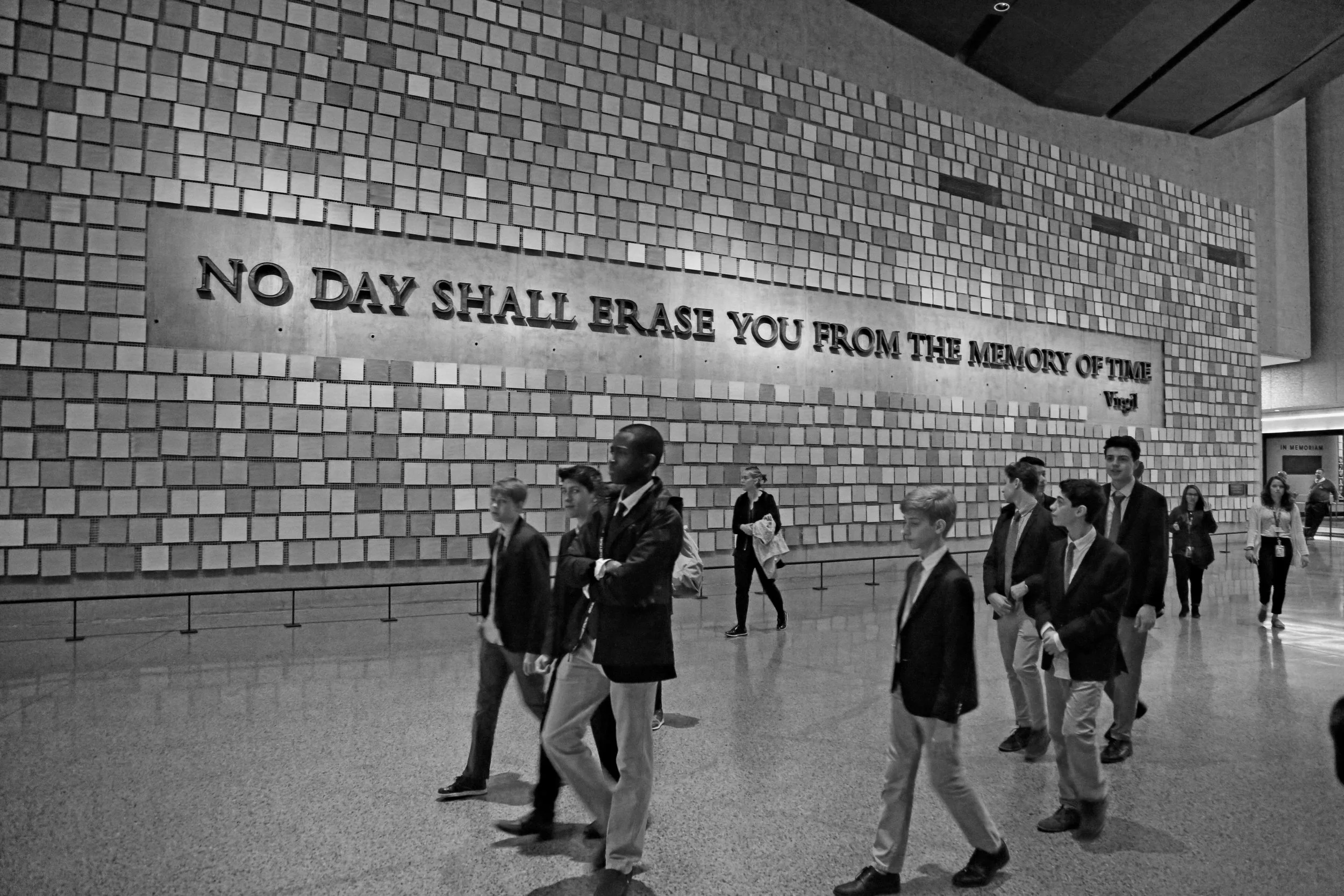
Browning boys tour the 9/11 Museum, 2019.
Putting September 11, into meaningful perspective, even 25 years later, remains difficult for me. Perhaps none of us could fully anticipate all that would follow from it in terms of government activity, international conflict, transportation safety, and how we ponder things like identity, security, freedom, and nationhood. And if our future was difficult to imagine on September 11, 2001, it can certainly be tricky to capture the significance of the day for those who can only see it in retrospect. Our boys have never known a time prior to the Patriot Act and TSA screening and the Department of Homeland Security. What was a cataclysm and a tragedy for so many in our city can be rendered banal without consistent historical memory and narrative empathy. Even commemorating the day in our current media climate can feel to some a partisan pronouncement on the last 25 years of domestic and international politics.
My purpose here is simply to remember, 25 years later, that the day itself was a dreadful thing, and to acknowledge that for many associated with Browning, that day’s deep feelings of fear, loss, and tragedy, and the efforts to make sense of those feelings, deserve our remembrance.
On that day in 2001, I was teaching a history class in suburban Washington, DC, when I learned about the attacks at the World Trade Center and the Pentagon. Our Head of Upper School broadcast the horrible news over the loudspeaker; that is the last thing that I recall with any certainty. The rest of the day is a patchwork of images and sounds in my memory: Rumors of an attack on the Capitol; televisions wheeled into classrooms to watch the news coverage (a practice later recognized as ill-advised); small, impromptu gatherings of faculty expressing their disbelief, fear, and anger; the sobs of boys in hallway as they worried about parents at work or traveling; the stricken looks of colleagues upon learning that some students had lost family in the attacks. The timeline of events that day and the days following remains blurry. What I have never forgotten, however, was how much all of us at school seemed to need the school and its relationships and its reassurances as a mechanism for processing something so awful.
And, so I gather, it was behind the Red Doors. Though I was not at Browning on that terrifying day, I have heard stories from those who were. In those stories, I heard some of the familiar beats--the senses of confusion and incredulity, of shock and terror, of chaos and concern—that I recognized from my own experience. It was not difficult for me to imagine that those emotions could be even louder and deeper here in New York, given the proximity of the attacks, the Towers’ shocking collapse, the horribly and impossibly tragic loss of life. But what was most notable—and most familiar—in what I learned was how Browning served as a sheltering home that day, a place where teachers and staff and administrators simply refused to leave, but instead made sure that boys were kept calm and safe until they were personally delivered into the care of parents who made their way to 62.
As we mark this terrible anniversary, let us remember that when tragedies, difficulties, and hurts inevitably arrive in our lives, we all need communities that guard our safety, keep us connected, offer us compassion, and encourage us to heal. These communities—for both children and adults—are so often formed in schools. We know from our more recent experience of the trauma of COVID-19 that schools are irreplaceable in the lives of children. Not just because they are physical spaces— although that too is worth remembering in the age of artificial intelligence—but because of humans who care for the children and families that schools serve. While we pause to remember all who were lost that day, and how irrevocably it changed our society, we can also reflect on how schools form a community that its members can rely on, come what may.