

One school. Every stage of boyhood.
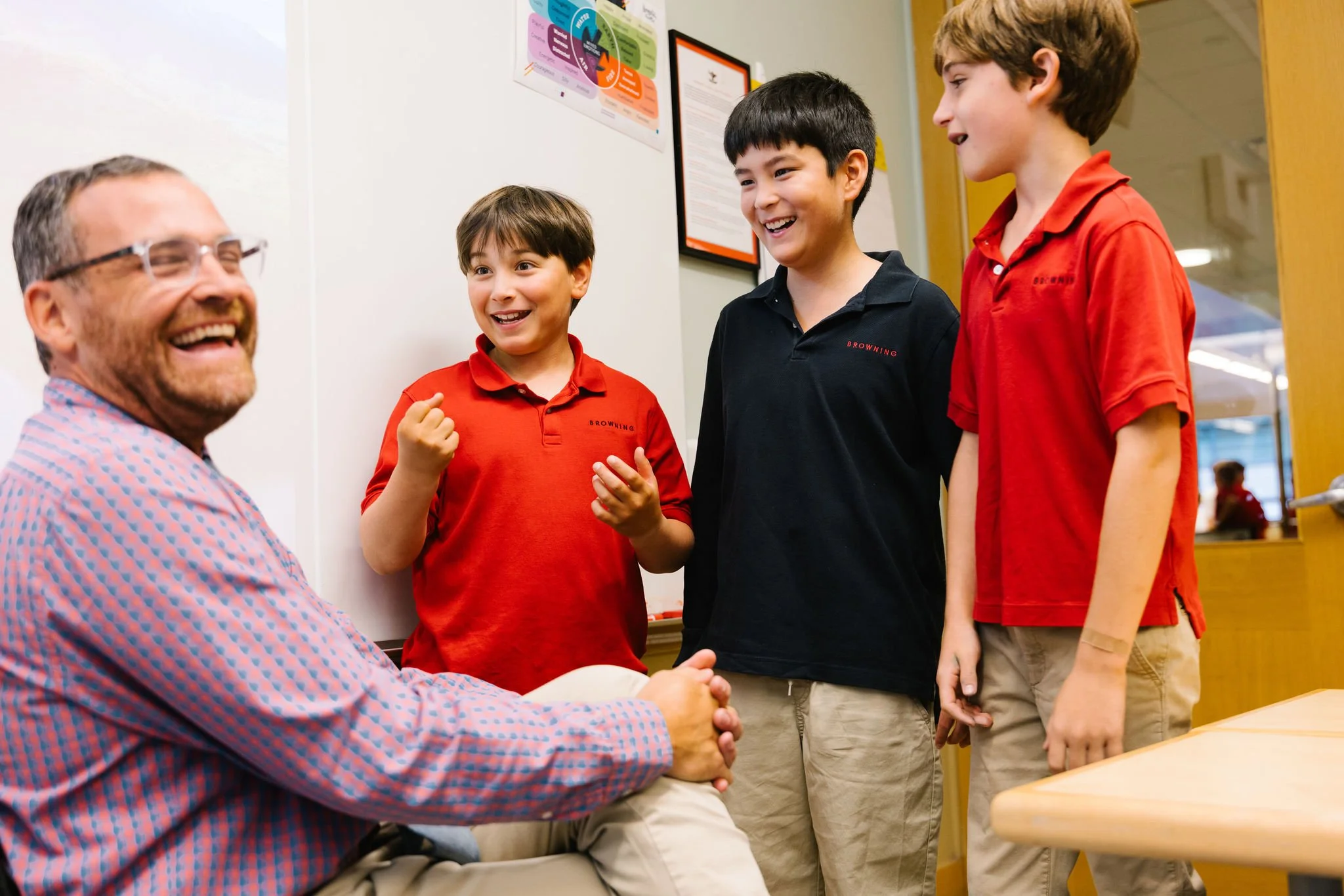
What are the benefits of a K–12 education?
A K–12 school can do more than provide continuity. At Browning, it allows us to think about a boy’s education as a whole: what he needs when he first walks through the Red Doors, how those needs change as he grows, and the knowledge, skills, relationships, and independence he will need when he graduates.
Because Browning is both K–12 and a boys’ school, our approach is grounded in an understanding of boys at every stage of their development. What begins in the Lower School grows more sophisticated in the Middle School and ultimately prepares boys for the independence and intellectual challenge of the Upper School. The result is not simply 13 years at the same school. It is an education designed to build from one stage of boyhood to the next.
What are the advantages of attending the same school from Kindergarten through Grade 12?
Continuity matters because education is cumulative. Teachers can build on what came before rather than starting over at each transition. Expectations can grow deliberately from grade to grade, and skills introduced to younger boys can be developed with greater sophistication as they mature.
Just as important, boys grow within a community that knows them. Over time, teachers come to understand how a boy learns, where he has grown, what challenges him, and when he is ready for greater independence—all without the high stakes external evaluation that applying to a new middle or upper school would involve. Longitudinal information about how your boy grows and learns best is better than a snapshot.
Does a K–12 school make transitions easier?
It can—and not simply because the surroundings are familiar.
At Browning, moving from one division to another is an important milestone. Expectations change. Boys encounter new teachers, greater academic demands, new responsibilities, and increasing independence. But they make those changes within a school whose values, educational philosophy, and understanding of boys remain consistent.
Instead of having to learn an entirely new school culture, new peers, and a new educational approach at the same time they are navigating a new developmental stage, boys can direct more of their energy toward the challenge ahead within a context that feels familiar, with adults who understand exactly the kind of education he has had before.
How does a K–12 education support academic rigor?
A strong K–12 program allows academic rigor to develop intentionally over time.
Teachers know what students will be asked to do in later grades and can build the foundations for that work earlier. The goal is not to push Upper School work down to younger boys. It is to make sure that each stage prepares them for the next.
At Browning, boys gradually take greater ownership of their learning: developing habits of studentship, learning to ask increasingly sophisticated questions, communicating their ideas clearly, engaging constructively with different perspectives, and ultimately doing the independent thinking expected of an Upper School student.
By graduation, rigor is not something suddenly imposed upon them. It is something they have grown into.
Will my son have enough opportunities to meet new people and reinvent himself?
Growing up in one school does not mean staying the same person.
Boys change enormously between ages 5 and 18, and a K–12 school should make room for that growth. New teachers, classmates, courses, activities, leadership opportunities, and new learning environments give boys repeated opportunities to discover new strengths and interests.
Browning admits students in almost every grade every year, with major entry points occurring in Kindergarten/KinderFirst, Grade 6 and Grade 9. Boys have plenty of opportunities to meet new friends in every grade, and peer groups shuffle quite naturally as children age.
What do younger students gain from having older students at their school?
At a K–12 school, younger boys can see where their education is taking them. Older students make the future tangible: younger boys see them performing, competing, leading, debating, creating, and contributing to school life. These interactions give younger boys role models, a stronger sense of belonging, and confidence that they, too, will grow into these opportunities.
But younger boys are not simply observers or recipients of mentorship. Their curiosity, enthusiasm, and participation help shape the character of the entire school and give older boys meaningful opportunities to practice patience, responsibility, and care. Over time, younger boys move from watching to participating and, eventually, to leading. As academic expectations increase, they can take the risks that growth and leadership require within the security of a community they have long known—and one in which they have always mattered.
How does Browning's K–12 model help teachers know each boy?
Knowing a boy well takes time. And at Browning we know that boys learn best when they are known, loved, needed and challenged.
A K–12 school has the opportunity to develop a deeper institutional understanding of a student across years: his interests and strengths, the ways he learns best, the areas where he needs greater challenge, and the ways those things change as he matures. It also allows him to experience being needed as an essential part of a school culture - whether helping younger boys, collaborating with peers, or strengthening brotherhood through sharing his talents with the community.
At Browning, relationships are central to rigorous education. Knowing a boy well allows a teacher to ask more of him—and to understand what support will help him rise to that expectation.
Why might a K–12 boys' school be different from another K–12 school?
Browning has the unusual opportunity to think about both education and boyhood across the full K–12 journey.
We can ask not only what a Kindergarten boy needs to learn, but what foundations he will need as a sixth grader, a ninth grader, and eventually a senior preparing for college and life beyond Browning.
Our understanding of boys therefore isn't confined to a particular age, and it isn't informed in relationship to girls. It is informed by seeing boys grow from childhood through adolescence and into young adulthood—and by continually adapting our teaching to meet them there.