A New Way to Explore Colleges from Home

The College Tour
In my November 2021 blog post, Return of the College Trip, I wrote: “In the midst of the pandemic, the college application season was surprisingly normal, at least from my vantage point. The search process was anything but.” The first casualty was the in-person college visit.
Applicants panicked. “How can we pick a school if we can’t visit?” (Although senior Logan Flynn ’20, pictured left, wrote an excellent Buzzer article detailing precisely that!)
Admission Offices panicked: “How are applicants going to experience our campus?”
Almost like air rushing in to fill the void after a lightning strike, “virtual” tours thundered onto the scene. Schools scrambled to have one readily available on their web site, but there was no consistency. Some were glorified slide shows, others had a more professional feel. There were even schools that offered “live” tours online, where a current student would walk around campus holding a phone.
It did not take long for hungry entrepreneurs, seeing a new, enormous, and desperate market, to leap into the fray. One company, called YouVisit, aggregated video tours from hundreds of colleges onto their site for a one-stop-shopping experience. They tracked visits and sold the data back to colleges so that admission offices could monitor interest. But the tours still varied dramatically in quality.
Then, in December 2020, a production company called The College Tour debuted a polished, professional-quality tour of Fort Lewis College in Durango, Colorado. Seven more followed in “Season 1,” and the portfolio has now grown to over 200 schools, most of which, truth be told, are not likely to be on the radar screens of New York City independent school kids.
That’s actually the good news. I hawk this series for two clear purposes:
First, learning about a school that is worthy of attention but that might not otherwise warrant an in-person visit. There are a few, like U Conn, UT-Austin, Occidental, and Tulane, that our kids routinely apply to, but several dozen others, including SUNY-Albany, Arizona State, Loyola Maryland, and Miami Ohio, that they often (or should) consider. The College Tour is an easy way for them to get a feeling for such schools without having to travel.
Second, any of these episodes can act as a primer for learning how to visit schools. They are highly scripted and formulaic, but if you listen closely and without judgment, they are extremely informative. The host, Alec Boylan (who reminds me, more than a little, of Jeff Probst from Survivor) gives an introductory overview, with breathtaking panoramic video, and then introduces a number of segments where current students or faculty detail specific aspects of the school: academics, clubs, athletics, dining options, community, traditions, and others. A Fort Lewis student talks about experiential learning and peer tutors. Roanoke students highlight the career center, studying abroad, and the benefits of distributional requirements. These are topics that kids should be inquiring about at every college they visit.
A few years ago, I showed a Grade 10 class the episode on the University of Puget Sound, a charming, small liberal arts college in the heart of a residential neighborhood of Tacoma, Washington. Then I asked them questions about what they learned. “It’s secluded in the mountains.” Nope. “I prefer a colder environment.” It’s farther north than Quebec City. “Does not seem rigorous.” Translation: “I’ve never heard of it, so how good could it be?” One boy wrote: “You had to be a music major or minor to access scholarships.” Then I replayed the segment, where the student being interviewed said clearly: “One thing that I appreciate most is that you don’t have to be a music major or minor to access scholarships.” Another kid bemoaned “their lack of sports,” although there was a three-minute segment on athletics, noting that 50% of the student body participated in NCAA, club, or intramural sports. Hearing what you don’t. Not hearing what you do. These are easy traps to fall into.
Watch an episode together and then discuss it. Maybe start with one of the ones I mentioned here. Ask each other questions. Recognize that people see things differently. Analyze that. Go back and verify what was actually said. Investigate some of the majors represented by the speakers. Pull out a map! Familiarize yourselves with the immediate location and the geographic region around the school. Then pick a very different school and repeat. This can be excellent practice for the real thing.
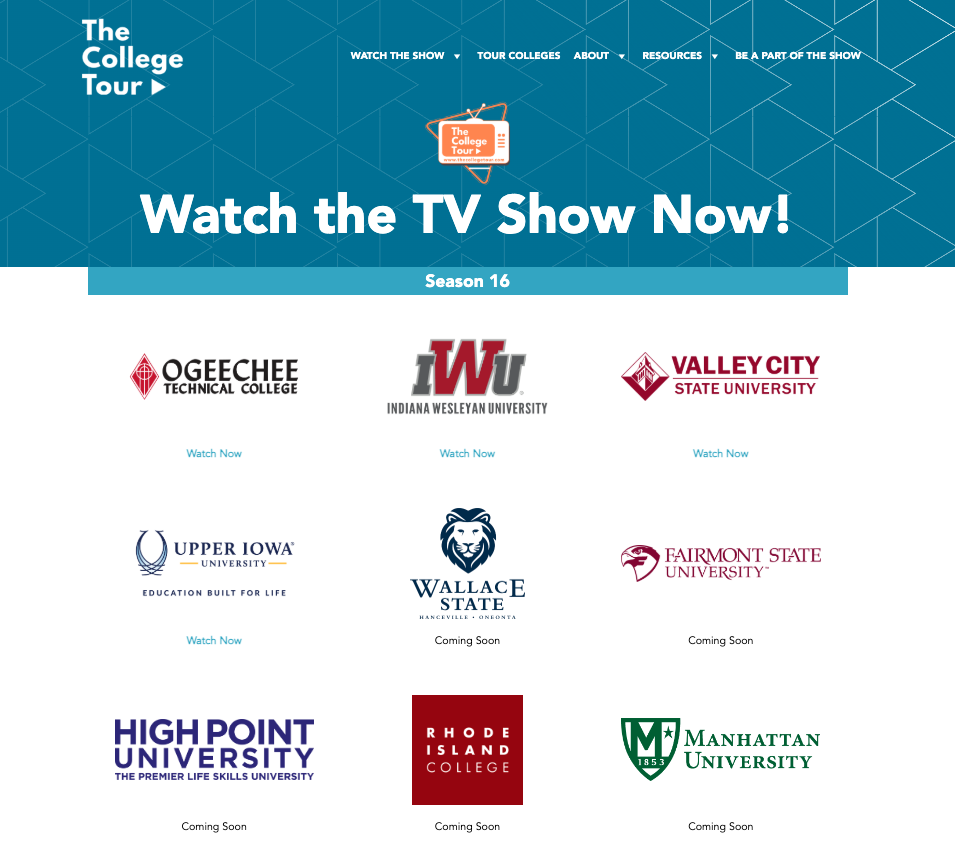
The full episodes can be found here, where they are organized by season.
There is also an alphabetical list, which links instead to the individual segments.
“This is The College Tour.”