
When You Exit the Highway, Start Looking Out of the Window
why 'noticing' will help any student get the most out of a college visit
Spring Break is looming. College students and high school seniors will flock to beaches for fun and frolic. High school juniors and their parents will embark, instead, on that other adolescent rite of passage, the college tour road trip. If you are among the cohort planning such an adventure, start by reading my pre-pandemic (but still spot-on) post “On Visiting Colleges.” Then, for the mechanics, a video tutorial and a treasure trove of maps can be found in Grade 10 and 11 Canvas portals. Personally, I love visiting colleges. I have trips planned this spring to Seattle, San Francisco, North Carolina, and central New York.
In the television series The Mentalist (2008-2015), the lead character is a former carnival “mind reader” who uses his keen observational skills to assist the California Bureau of Investigation in solving crimes. In one episode, when asked by a reporter how he does that, he answers: “I notice things.”
That has become my mantra to the kids as I prepare to take them on our Annual College Trip. I ask them to become “mentalists” and to pay attention to their surroundings. To notice things.

During the pandemic, when in-person visits were unavailable, one of my juniors, scrolling through countless slideshows, discovered that there was often a picture of the campus coffee shop. For some schools, the kids in those photos seemed actively engaged with each other while at other schools, the kids appeared more solitary. That mattered to him. So pay attention to the kids: do they appear happy, healthy, and engaged?
Look at the classrooms. They don’t have to be modern, sleek spaces packed with state-of-the-art technology. They do have to be conducive to the learning that takes place within them. Are they inviting? Welcoming? If there’s a class going on, are the kids active participants or playing games on their laptops?
In a parent coffee a while back, I had a mother say, with a little bit of a huff: “You know, Mr. Pelz, they’re just picking colleges by the architecture!” My response was polite, but if architecture matters to your kid, let it matter! He’s looking for a place to call home for four years; he needs it to be inspiring and not depressing.
At Dickinson College, all of the parking signs are in English and a second language, like Greek, Italian, or Russian. That tells you something about the school’s commitment to internationalism. Dig a little deeper. Tug on the thread, where does it lead? At Bowdoin College, there’s a big glass box with an elevator inside, sitting all by itself. Obviously there’s something underground; turns out it’s a library. But it says something about the way a college values outdoor space that they would bury such a critically important multi-story structure below ground. At Emory & Henry there’s a Duck Crossing sign. At Amherst College a paleontology museum. At Beloit an entire building for anthropology. There’s a message in each about institutional priorities.
What are their monuments? What does the school celebrate? Why do the fire hydrants have poles sticking up from them? Why does nearly every campus have a 50-foot smokestack looming somewhere? Why are there so many Olin Halls? Look at the student art work, the performing arts spaces, the science labs. Take time with the panels of student research lining the walls of the academic buildings.
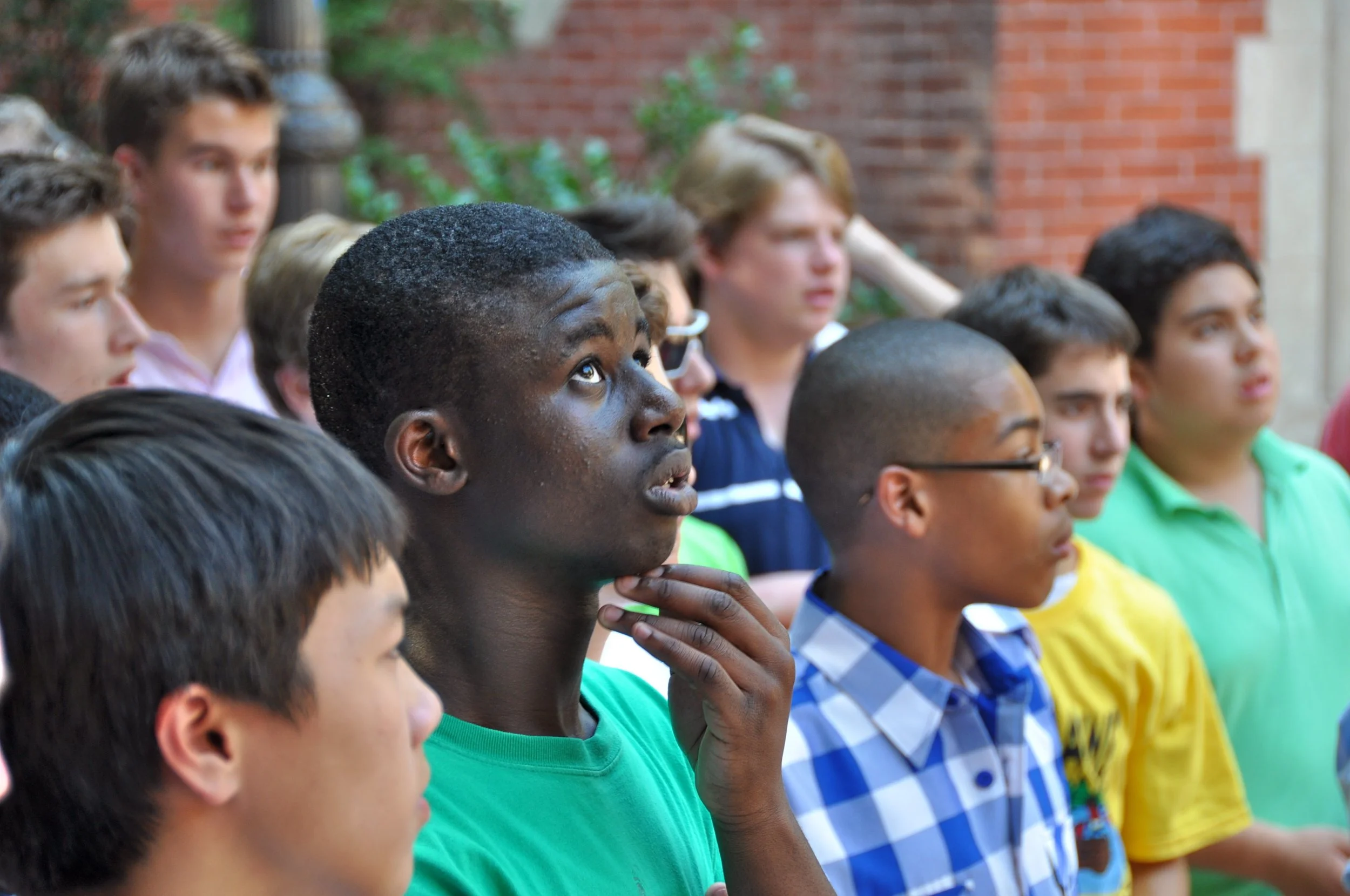
Look up. New Yorkers don’t look up enough, but there are wonderful sights to behold when you do. And listen. Hear the water flowing in the simulated babbling brook inside that atrium? How about the horn of the freight train skirting the edge of campus? And where are you? What’s nearby? In advance of the College Trip, I tell kids, “When the bus exits the highway, start looking out the window.”
On each college campus, you get one shot with a tour guide. Make the most of it. Pay attention. Hang on every word. Follow the vocabulary. If they talk about “Jan term” or “short term” or “drop/add” or “shopping” or “rush,” make sure you understand. Ask them to explain or make a note of the term and look it up later.
Ask clarifying questions. Good questions make the responder stop and think, rather than just reciting a scripted bullet point.
One of my standard questions is “what’s a course you took that surprised you?” Answers often fall into one of two categories: a course that they took reluctantly in order to satisfy a distributional requirement but ended up loving, or a course they took in an intended major that prompted them to find a new major. Both of those responses can be eye-opening, but only if internalized. Pay attention.