
Celebrating the Class of 2026
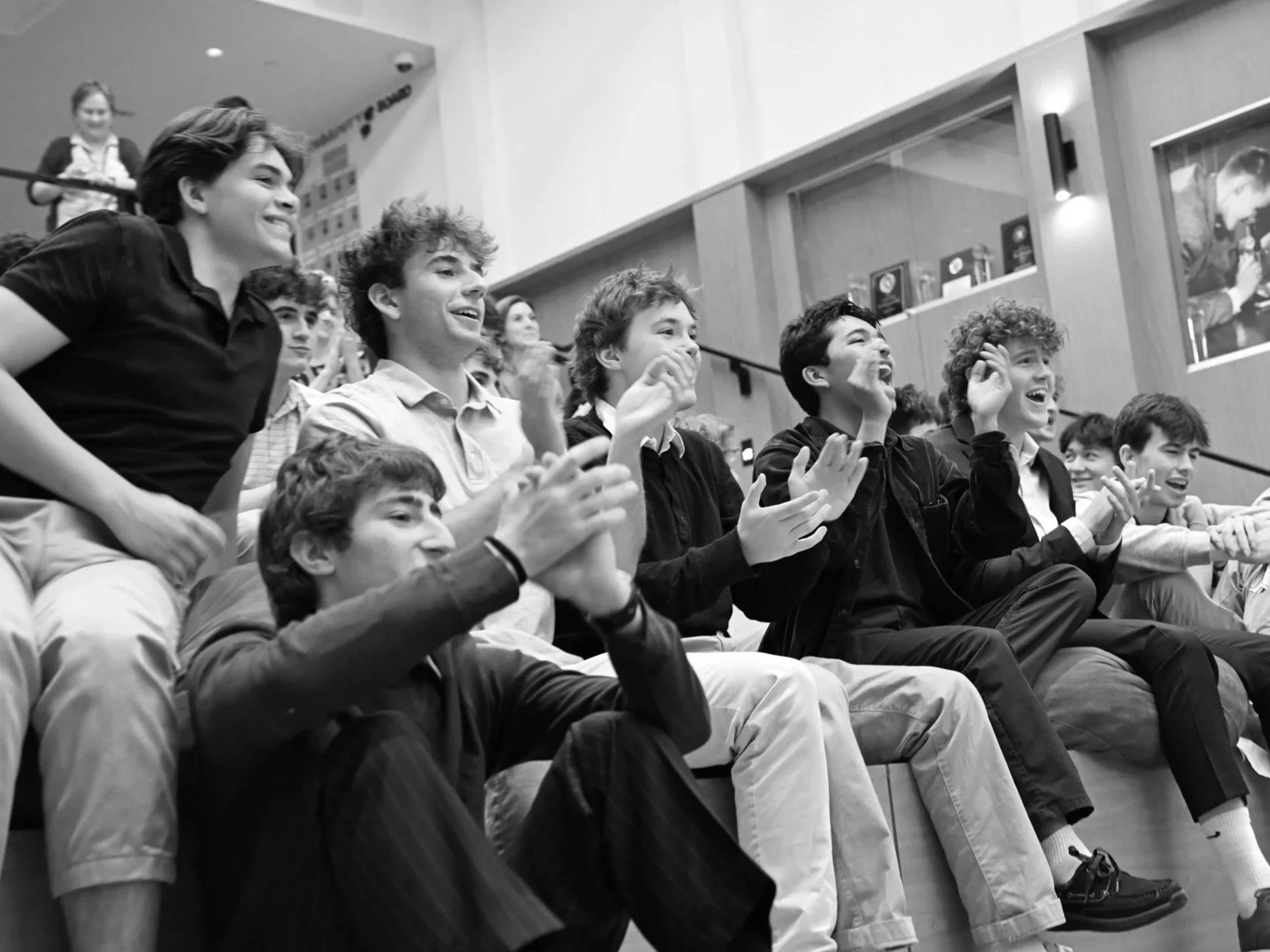
This has been the opening year of Browning’s Four Core Skills program, a series of classes and activities throughout the Middle and Upper Schools designed to equip our students with specific capacities—for interpersonal connection, constructive dialogue, studentship, and storytelling—that our world often neglects in boys. Part of this work culminated last month in our first annual Senior Storytelling Festival, which brought all our Grade 12 boys together so that each could share a short true story about themselves. Thanks to excellent teaching and organization, and owing to the honesty, creativity, and vulnerability of the boys themselves, the night was a triumph of good tales and good fellowship.
And the singularity of the Festival leads me to reflect on the Class of 2026 in general, and the stories that it has collectively told over the course of their Browning careers. There are, for me, a trio of motifs which have informed their expression and their activity, and from which all of us might take some guidance.
The first theme asserts the priority of passion and purpose. Our graduating seniors achieved a great deal behind the Red Doors—curricularly and co-curricularly, athletically and artistically—yet as commendable as those accomplishments were, what was most notable was the manner in which they were realized. The Grade 12 boys set goals for themselves, certainly, but the accolades they earned seemed decidedly secondary to the actual activity that led them to those same accolades. It is pretty great to claim athletic championships, to win robotics and debate competitions, and to earn certificates of academic distinction; it is perhaps greater still simply to love playing squash and baseball and table tennis, to love tinkering and building, to love rhetoric and discussion, to love exploring new ideas for their own sake. This group achieved not merely because it embraced achievement, but because it enjoyed the work itself.
The second motif of the 26ers’ story involves the significance of social warmth. A school like Browning seeks to be a site of deep, meaningful inclusion, the kind which guarantees that each community member can be their authentic self without fear of disdain or dismissal. This effort demands real structural commitment to horizon-broadening programs, consistent mentoring and modeling, and a curriculum of both mirrors and windows. But my experience has been that structure alone is seldom enough; indeed, it takes a culture of welcome, activated by student leaders, to enliven programs, models, and curricula. What I have appreciated about our graduating seniors has been their readiness to extend gestures of humanity—the warm handshake, the easy smile, the use of name, the genuine question—to all members of the Browning community. While politesse can sometimes be superficial, with these boys it was a tool of connection, a way of leveling hierarchies and bridging gaps. It makes a difference in a school when its Grade 12 boys refuse to pass others—be they younger students or older teachers—without saying hello and asking them how they are doing.
A staunch rejection of false scarcity describes the final theme of our graduating class’s story. These boys have grown up in a time and place which too often tells them that there is not enough to go around, that the only way to live well is to grab everything you can with both hands before someone else does the same. Yet again and again, the Grade 12 guys resisted such zero-sumism, and instead invoked the power of solidarity and mutuality. They chose to support each others’ projects, to nurse each others’ hurts, to encourage each others’ wellbeing, and to cheer each others’ triumphs. As their journey together culminated, they saw the achievement of an individual or subgroup not as a threat to their own personal status or place in the world, but rather as an occasion for joy, togetherness, and the recognition that a victory for one was, in its very real way, a victory for all.
At Browning, we have focused our curricular attention on storytelling because we subscribe to the axiom that if one doesn’t tell one’s own story, someone else will. In a world where the stories of and about young men are often told by others in reductive ways, it is vital that individual boys learn to state and to show who they have been, who they are, and who they intend to be. And when a class of boys is able to tell its stories both literally and figuratively, both as individuals and as a collective, it warrants our attention, our reflection, and our commendation.
Congratulations to the Class of 2026, all the best to the Browning boys who are coming up behind them, and a happy, healthy, safe summer to all!